Buying
LED neon vs glass neon: which one is right for you?
How LED neon and real glass neon differ in look, power, heat, noise, durability, lifespan and cost, and which one suits homes, events and businesses.
Updated
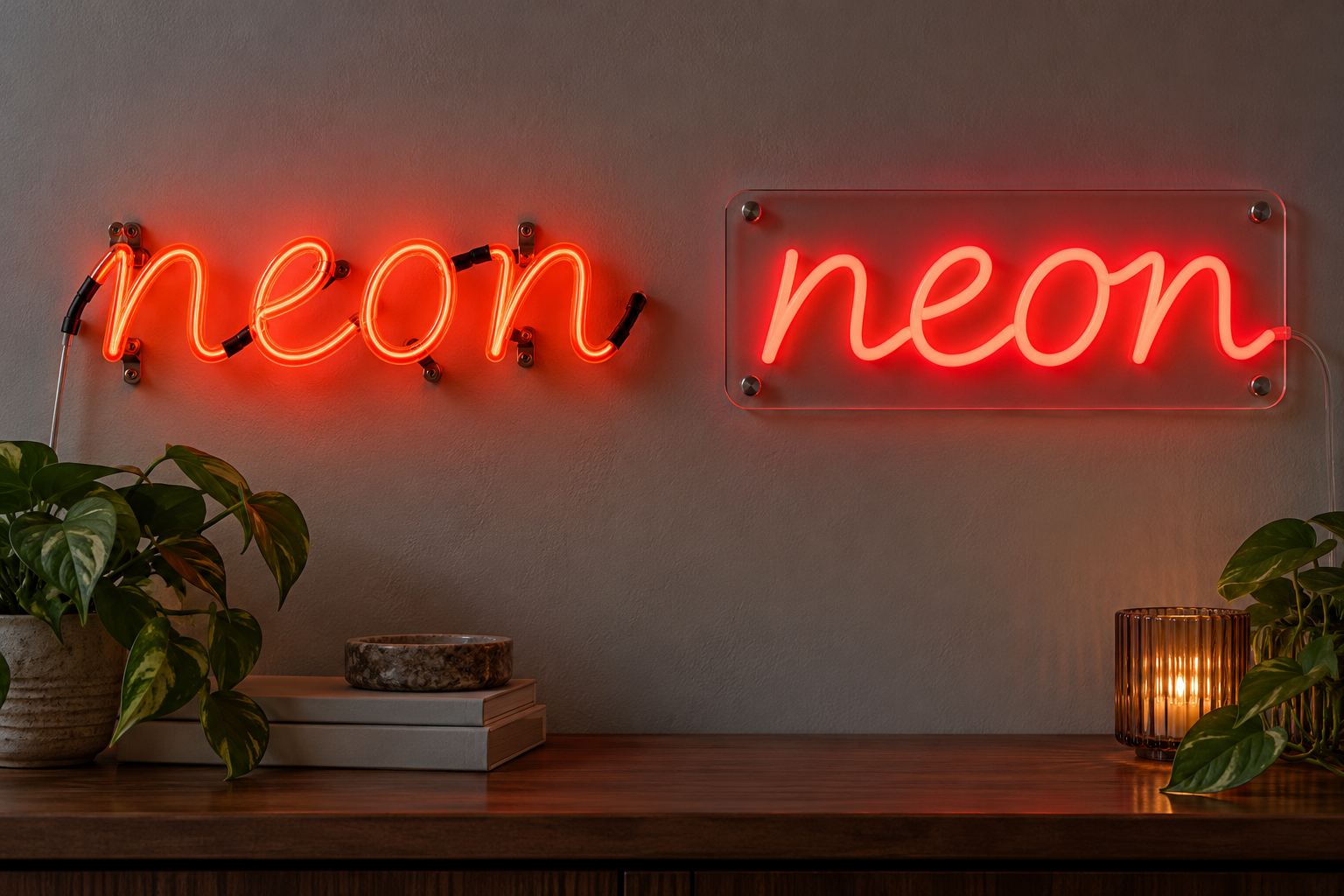
Both are called neon, but only one of them has neon inside. Real neon is a glass tube filled with gas that glows when high voltage runs through it. LED neon is a flexible silicone tube lit by small LEDs, made to give the same continuous line of light. We make both, so this guide is not about selling you one over the other. It is about picking the one that fits how you will use the sign.
The short answer
- Choose LED neon for homes, weddings, parties, shop interiors, offices and most outdoor spots under a roof. It is low voltage, ships well, comes in 18 colors or color changing, and costs less.
- Choose real glass neon when you want the original look of glowing gas, the sign will stay in one place, and you are happy to pay more and wait longer for it.
A short history
Neon lighting was first shown in public in Paris in December 1910, by the French engineer Georges Claude. In 1923 a car dealer in Los Angeles bought two neon signs for his showroom, usually named as the first neon advertising signs in the United States. For most of the century that followed, a neon sign meant glass bent by hand. LED neon arrived much later as a way to get the same unbroken line of light from LEDs at low voltage, and today both are made side by side.
How each one makes light
Glass neon
A glass neon tube is bent by hand over a flame to a full-size pattern, then emptied of air and filled with neon or argon. A transformer raises the voltage to several thousand volts, and the gas glows along the whole tube. Pure neon gives red-orange. Argon with a tiny drop of mercury gives blue, and most other colors come from coatings inside the glass. Where the tube jumps from one letter to the next, the glass is painted black so that part stays dark.
LED neon
In our LED neon signs, a strip of LEDs sits at the bottom of a groove routed into a clear acrylic backboard, with a silicone tube pressed in on top and sealed with glue. The silicone spreads the small points of light into one smooth line, and the sign runs on 12 V DC from a plug-in adapter. Our guide to what LED neon is goes through the build in detail.
Side by side
| LED neon | Real glass neon | |
|---|---|---|
| Light source | LEDs under a silicone tube | Neon or argon gas in a glass tube |
| Voltage at the sign | 12 V DC | Several thousand volts from a transformer |
| Power | About 8 to 12 W per meter of tube | More than LED for the same length |
| Heat | Runs cool | Gets warm |
| Sound | No transformer; adapter has no fan | The transformer can hum |
| Light | Mainly to the front, a crisp even line | All round the tube, a soft haze on the wall |
| Weight and handling | Light and flexible, ships well | Heavier glass, needs careful handling |
| Colors | 18 colors | 16 glow colors |
| Color changing | Yes, RGB with a remote | No |
| Fine detail | Tiny parts UV printed on the board | Limited; some details are simplified |
| Outdoor | IP67 outdoor build | Outdoor build specified when ordering |
| Installation | Plug-in adapter, mounting kit included | Heavier, with a transformer to place |
| Making time | 15 to 20 days after proof approval | About 4 weeks |
| Repairs | 2-year warranty with free repair | Usually the transformer or an electrode |
| Starting price | From $189.99 (20 in text) | From $479.99 |
Look and light
Glass neon glows all the way around the tube, so it lights the wall around it with a soft haze. Many people love it for exactly that. The light comes from the gas itself, which gives it a depth that is hard to copy.
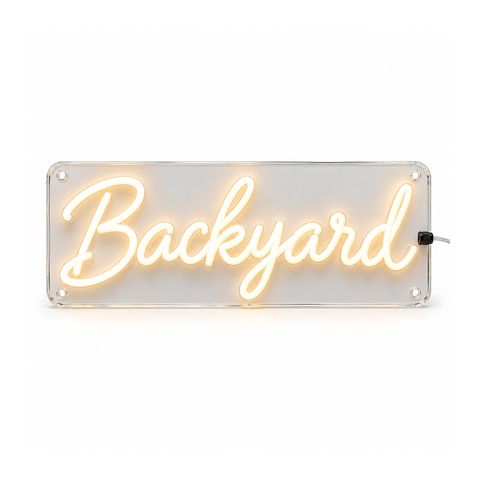
LED neon lights mainly toward the front, which keeps the line crisp and even, and the included dimmer lets you set the brightness for the room or the camera. Switched off, LED neon with a white tube looks milky white on clear acrylic, so the sign blends into a light wall during the day; see neon colors on and off. LED neon can also change color with a remote, which glass cannot do. If the sign is mainly for photos or video, read neon signs in photos and video.
Power, voltage and safety
This is the biggest practical difference. An LED sign runs at 12 V, and the plug-in adapter that turns your 100 to 240 V outlet into 12 V is a cULus Listed power supply (file E466625) with CE, FCC, SAA and RoHS marks. It is Class II double insulated, fully encapsulated and has no fan. The power supply and the LED light source are the certified parts of the sign. At 8 to 12 W per meter, a sign with 13 ft (4 m) of tube draws about 32 to 48 W; our energy use guide shows how to work out your own.
Glass neon needs a high-voltage transformer and generally draws more power than LED neon of the same length. It is a sign to mount properly and leave in place, not one to move from party to party. For a room where children play, LED neon on a high wall is the easier choice; see are LED neon signs safe for how to install one well.
Heat, noise and handling
- Heat. The LED tube runs cool. Glass neon gets warm in use, so give it space and keep it where hands will not rest on it.
- Noise. A glass neon transformer can give a low hum. An LED sign has no transformer, and its adapter has no fan.
- Handling. Glass is heavier and more fragile in shipping and handling. A crack lets the gas out and that tube goes dark.
- Mercury. Blue and many other glass colors use argon with a small drop of mercury. If a tube ever breaks, open the windows, do not vacuum, pick up the pieces with gloves and stiff paper, seal them in a container and take them to a hazardous waste or recycling point.
Durability, lifespan and repair
LED neon is flexible and will not shatter like glass, which matters in shipping, at events and in busy shops. The LED tube has a rated life of 50,000 hours, about 17 years at 8 hours a day, and every LED sign carries a 2-year warranty with free repair.
There is no single lifespan figure for glass neon. It depends on the transformer, the electrodes, the gas and how many hours a day it runs. A well-made glass tube that is left alone rarely fails, and when a glass sign does need work after years, it is almost always the transformer or an electrode, both repairable. Our glass neon care and repair guide covers what to look for.
Cost
Glass neon costs more because each tube is bent by hand, pumped and filled one at a time. Our custom LED neon starts at $189.99 for a 20 in text sign, and real glass neon starts at $479.99. Our price guide explains what moves the price for each.
How to tell which one you are looking at
- Switch it off. Glass is a clear or coated hollow tube. LED neon is a solid, soft-looking tube, often milky white, set into a clear board.
- Look between the letters. Glass neon has black-painted sections where it jumps from one letter to the next.
- Follow the cord. A small 12 V plug-in adapter means LED. A transformer means glass.
- Listen. A glass neon transformer can give a low hum.
Which one for home, events and business
| Use | Better fit | Why |
|---|---|---|
| Bedroom, nursery, living room | LED | 12 V, cool tube, dimmer included |
| Wedding, party or event sign that travels | LED | Light and easy to store; an 8 x AA battery box gives about 4 to 5 hours per set |
| Color changing or several colors | LED | RGB with a remote; several fixed colors at no extra cost |
| Detailed logo | LED | Tube plus UV print, or a printed backboard |
| Covered patio, porch or outside wall | LED | The IP67 outdoor build |
| Bar, restaurant or shop that hangs it once | Either | Glass for the original look, LED for less cost and upkeep |
| Collector or vintage-style piece | Glass | The glow of real gas |
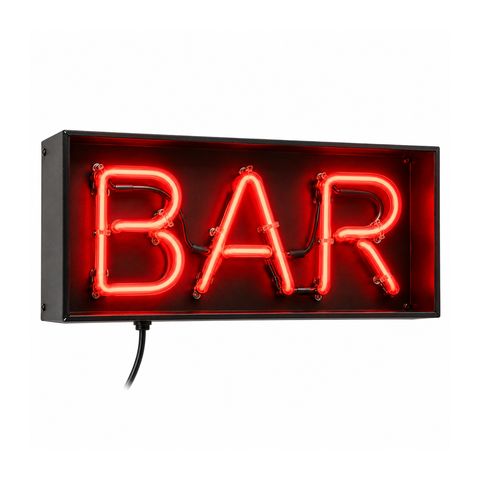
| Back-bar sign | Glass in a box | A black steel box protects the glass and hides the transformer |
Glass has limits with very fine detail and thin strokes, and our designer will tell you before production if part of a design must be simplified.
Ordering either one
Both start the same way: a free design proof, unlimited free revisions, and nothing is made until you approve it. Try your words in the neon designer for LED, or start a real glass neon sign and tell us what you have in mind. If you are still not sure which suits your space, ask us and we will help you choose.
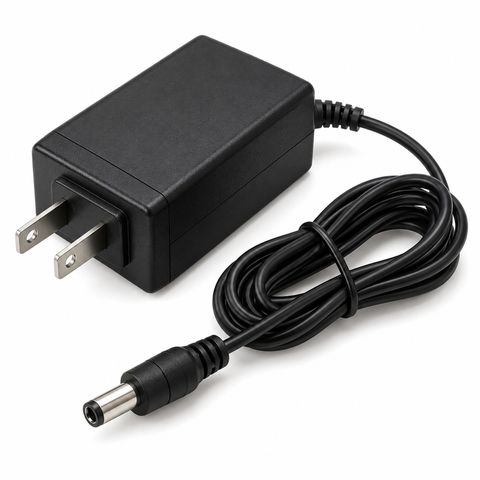 Replacement Power Adapter for LED Neon Signs