Buying
What is LED neon? How an LED neon sign is built
What LED neon is made of and how it becomes a sign: silicone tube, LED strip, groove in acrylic, curved corners, outlines, heat, power and lifespan.
Updated
LED neon is the modern way to get the look of a neon sign. It gives the same unbroken line of colored light, but it is made from LEDs and silicone instead of glass and gas. This guide explains what is inside the tube, how we build it into a sign, and why some parts of your design may come back a little different on the proof.
What LED neon is made of
An LED neon sign has four main parts:
- The LED strip. A narrow strip of small LEDs that makes the light.
- The silicone tube. A flexible tube that sits over the LEDs and spreads the light of each small LED into one smooth, even line. Some LED neon is made with a PVC tube; ours is silicone.
- The backboard. A clear acrylic sheet, 6 mm (about 1/4 in) thick as standard, with grooves routed into it to hold the tube.
- The power. A plug-in adapter that turns your 100 to 240 V outlet into 12 V DC, plus a dimmer.
The light comes out mainly through the front of the tube, toward the room, which keeps each line crisp. There is no gas, no glass and no high voltage at the sign. If you are weighing it against the original, our guide to LED neon vs glass neon compares the two.
How the tube goes into the sign
- Your design becomes tube paths. We redraw your words or logo as the lines the tube will follow.
- A groove is routed into the acrylic. The machine cuts a channel along every tube path.
- The tube is fitted. The LED strip sits at the bottom of the groove, the silicone tube is pressed in on top, and it is sealed with glue.
- The board is cut to its final shape. A clean outline, a rectangle, a circle or separate letters.
- It is wired to 12 V. The sign connects to the adapter and the dimmer you chose.
Our guide to how custom neon signs are made follows each step from your idea to your wall.
Why corners are curved
A tube can bend smoothly, but it cannot fold to a sharp point. So sharp corners in a font or logo are rounded to about 3/4 in (20 mm), and the tube ends are round. On a script font you will barely notice. On a block letter like an E or a star with pointed tips, the corners look softer than the typed version. The proof shows exactly how every corner will look before anything is made.
Centre line or outline: how letters are drawn
Not every letter is drawn the same way. It depends on how thick the stroke is.
| Part of the design | How we draw it in tube |
|---|---|
| Thin script and thin lettering | One tube along the centre line of each stroke |
| Bold block letters | Tube around the outline of each letter |
| Solid shapes (a filled heart, a thick logo mark) | Tube around the outline |
| Tiny text, fine lines, small details | UV printed on the board |
A centre-line script reads as one glowing line, the classic neon look. An outlined bold letter shows the shape of the letter as a glowing border. If you want one look or the other, our guide to the best fonts for neon signs shows which fonts give which result.
When a detail is too small for tube
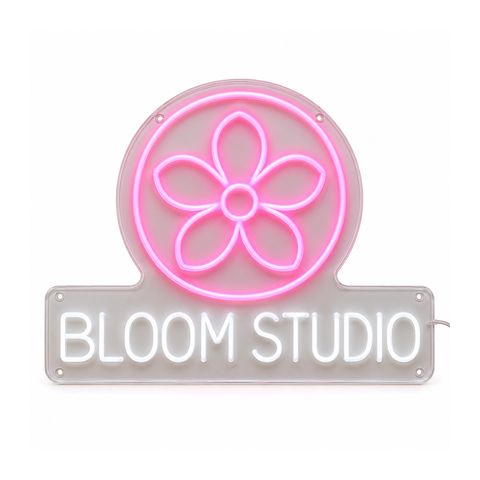
Some details are simply smaller than a tube can draw: a tagline under a logo, a thin border, a small leaf. Instead of leaving them out, we UV print them on the board, so they are still there when you look at the sign. They do not glow like the tube.
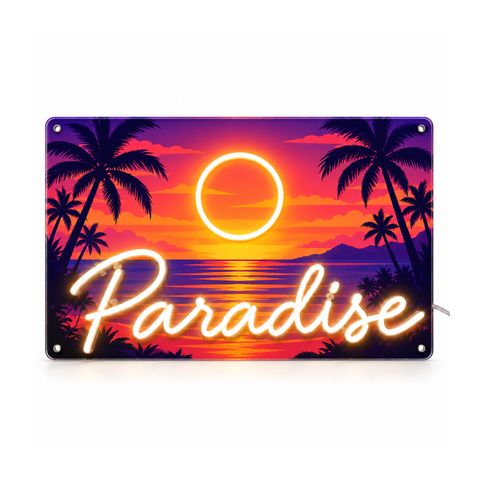
If your artwork has many colors, gradients or lots of small text, the neon sign on a printed backboard prints the whole logo in full color on the acrylic and traces the main lines in neon on top. It shows the full design even when it is switched off.
White tube or colored tube
The silicone tube comes in two kinds. A white tube looks milky white when the sign is off and shows its color only when lit. A tube made of colored silicone stays colored when off, and its lit color looks a little stronger. A white tube disappears more on a light wall in daylight; a colored tube keeps the design visible all day. If the switched-off look matters, say so when you order and we will confirm it on your proof. Our guide to neon colors on and off has more on choosing.
One color, several colors or color changing
- One color. Pick from 18 tube colors, from warm white to deep blue.
- Several colors. Give each word or part its own color. Several colors in one sign cost nothing extra.
- Color changing (RGB). From a touch remote with a color wheel, you can set one fixed color or let the sign cycle through colors. This costs extra. See dimmers and RGB for how the controls work.
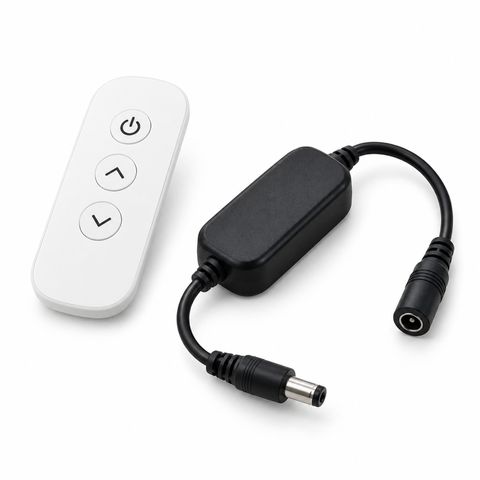
Every single-color sign comes with a dimmer, either on the cable or with a remote, so you can turn it down to a soft glow.
The backboard
The backboard holds the tube and decides how the sign sits on the wall. You can choose a clear board cut to the shape of the design, a rectangle, each letter on its own board, no backboard, or a printed board. Stock finishes include clear, black, colors and mirror, and other colors can be made to order. We keep shapes clean: circles for round logos, rounded rectangles for text, small corner radii, and no wavy outlines held together by thin bridges. A flame-retardant polycarbonate board can replace acrylic when a venue or fire inspector asks for it. More in our backboard options guide.
Power and what it draws
LED neon draws about 8 to 12 W per meter of tube, roughly 2.4 to 3.7 W per foot, so a sign with 13 ft (4 m) of tube draws about 32 to 48 W. The plug-in adapter is a cULus Listed power supply (file E466625), also marked CE, FCC, SAA and RoHS, Class II double insulated and fully encapsulated with no fan. The power supply and the LED light source are the certified parts of the sign.
For a table, booth or backdrop with no outlet nearby, an 8 x AA battery box runs the sign for about 4 to 5 hours per set of batteries. You can choose it with your sign at no charge, as well as the plug. Our power options guide compares the choices.
Does it get hot, and how long does it last?
The LED tube runs cool. That matters in bedrooms, nurseries and at events: there is no hot glass and no high voltage at the sign. See are LED neon signs safe for how to place and install one well.
The LED tube has a rated life of 50,000 hours. That is about 17 years at 8 hours a day, or about 11 years at 12 hours a day. A rated life is a measure of how long the LEDs keep their light under test, so a sign does not simply switch off at that point; our guide to how long LED neon signs last explains what it means and what shortens it. Every LED sign also has a 2-year warranty with free repair.
Brightness is in your hands: the included dimmer turns the sign down to a soft glow for a bedroom or up for a busy room.
Indoor and outdoor
The standard build is for indoor use. The outdoor build uses an IP67 rated tube and sealed parts, with a test report. IP67 means dust-tight and protected against short immersion in water. The sign still lasts longest under a roof or awning, and the adapter and plug must stay dry. Our indoor vs outdoor guide explains where an outdoor sign lasts longest.
What comes with every LED sign
At no charge, every LED sign comes with its backboard, a dimmer (in-line or remote), the mounting kit for the way you want to install it (wall standoffs, ceiling cables, no-drill adhesive mounts or a clear free-standing base) and the plug-in adapter. The design proof is free too, with unlimited revisions.
Try it
The quickest way to see how your words will look as tube is to type them into the neon designer. It shows the font, color and width, and we send a proof before anything is made.
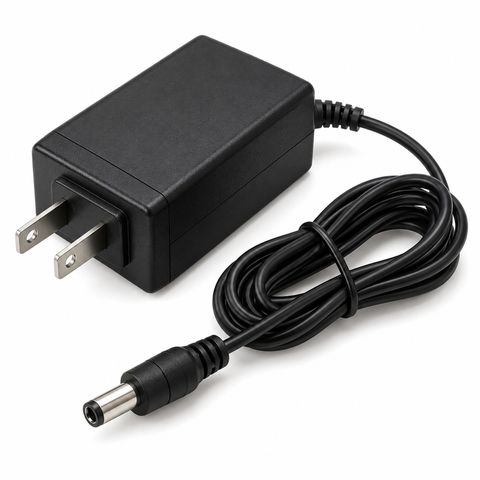 Replacement Power Adapter for LED Neon Signs