Buying
How long do LED neon signs last? Hours and years
What a 50,000-hour rating means in years, what usually wears out first, how heat, sun and dimming change the answer, and how our 2-year warranty works.
Updated

A neon sign is something you buy for years, so it is fair to ask how many. The honest answer has two parts: how long the LED tube is rated for, and how long the parts around it last. This guide explains both, turns hours into years, and shows what you can do to stretch them.
The short answer
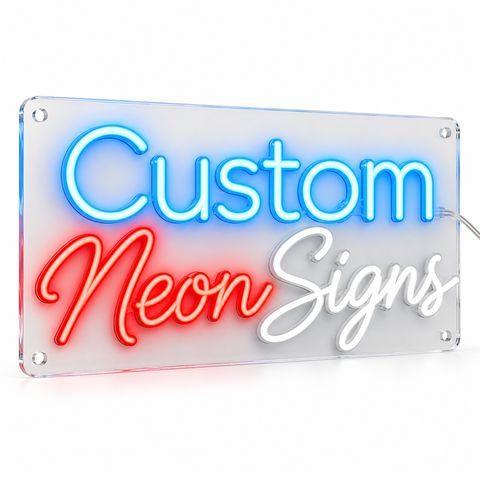
The silicone LED neon tube in our signs is rated for 50,000 hours. At a typical 6 to 8 hours a day, that is well over a decade and a half. In practice, the plug-in adapter, a connector or the dimmer is more likely to need attention before the tube does. Those parts are simple to replace, and our signs carry a 2-year warranty with free repair.
What 50,000 hours means in years
The table divides 50,000 hours by the hours you run the sign each day, every day of the year.
| On each day | Hours per year | Years to 50,000 hours |
|---|---|---|
| 4 hours (evenings) | 1,460 | about 34 |
| 6 hours | 2,190 | about 23 |
| 8 hours (a shop day) | 2,920 | about 17 |
| 12 hours | 4,380 | about 11 |
| 18 hours | 6,570 | about 7.6 |
| 24 hours (never off) | 8,760 | about 5.7 |
A sign in a bedroom that glows for a few hours a night will likely outlast the room’s paint color. A bar sign that never goes off reaches the rating much sooner, which is a good reason for a timer.
What “rated life” actually means
LEDs very rarely burn out the way old bulbs did. They fade slowly as they age. That is why life ratings for LEDs are usually defined as the number of hours until light output falls to about 70 percent of what it was when new (often written as L70), not the hour the light goes out.
Two things follow from this:
- At the end of its rated life, a sign still lights. It is dimmer than it was, and the change is gradual.
- The rating is a lab figure. How the sign is used, and especially how hot it runs, decides how close real life comes to it.
What usually fails first
In LED lighting of all kinds, the power electronics are the most likely point of failure, not the LEDs themselves. Neon signs follow the same pattern. When one of ours stops working, the cause is usually one of these:
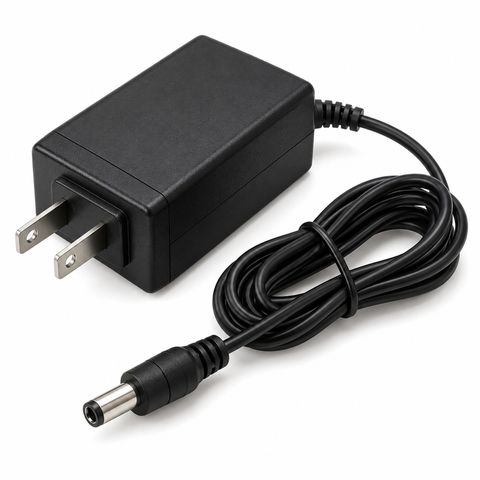
- The plug-in adapter. It does the work of turning wall power into 12 V DC. Ours is a cULus Listed power supply (E466625), Class II double insulated, fully encapsulated, with no fan.
- A connector. The DC barrel plugs between adapter, dimmer and sign can work loose, especially on signs that travel to events.
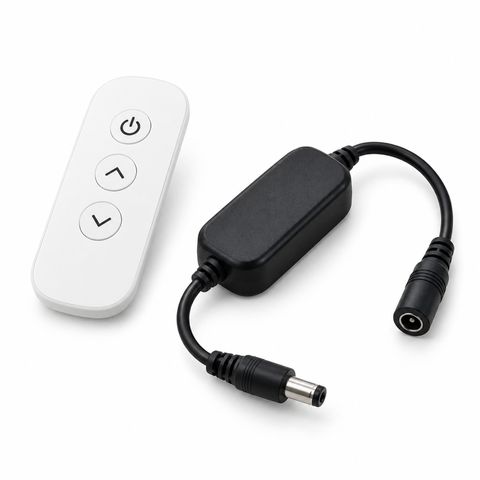
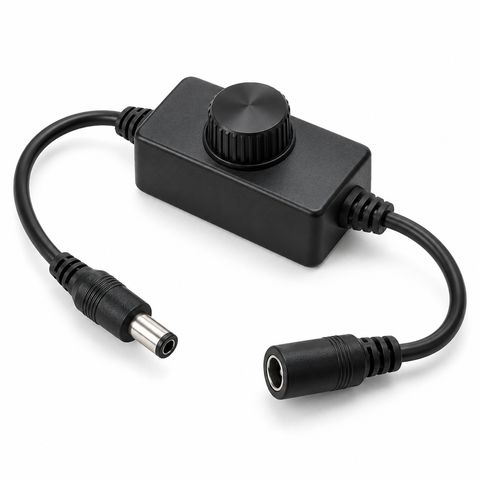
- The dimmer or remote receiver. It sits on the cable and takes the knocks.
- The cable. A cable that has been yanked, pinched in a door or bent sharply at the plug can fail.
All of these unplug and plug back in. A replacement power adapter is matched to your sign: tell us the order number or the sign’s size, or send a photo of the old adapter’s label. A new remote dimmer or in-line dimmer takes a minute to fit. If your sign has stopped working, our troubleshooting guide walks through what to check first.
What shortens a sign’s life
Heat. The hotter LEDs run, the faster their light fades. Keep signs out of all-day direct sun, away from heaters and fireplaces, and out of closed boxes or cabinets while lit. Give the adapter open air too: not under a cushion, a rug or a pile of coats.
Water. An indoor sign belongs in a dry room. Anywhere with splashes or steam, choose the outdoor build, which is IP67 rated with a test report. The adapter stays dry either way. Our guide to indoor and outdoor neon signs has the details.
Bending and pulling. The tube is pressed and glued into a groove in the acrylic. Lift the sign by the board, not the tube, and never carry it by its cable.
The wrong adapter. Use the 12 V adapter that came with the sign. Adapters are sized to the sign, so one borrowed from another device may not supply the right voltage or power.
Dimming and timers
Every LED sign comes with a dimmer, either an in-line knob or a remote. Running the sign below full brightness means less heat, and less heat means the LEDs age more slowly. Most rooms look better with the sign turned down a little anyway, especially at night.
A plug-in timer on the outlet does the rest. Switching the sign off for the hours nobody sees it is the simplest way to spread 50,000 hours over more years. It also saves power: our signs draw about 8 to 12 W per meter of tube. Our guide to neon sign energy use shows what that costs.
LED neon and glass neon
Real glass neon ages differently. The glass tube itself rarely fails; when a glass sign needs repair after years, it is almost always the transformer or an electrode, and both can be repaired. Our comparison of LED neon and glass neon covers how the two differ in daily use.
Warranty and repairs
Our LED signs carry a 2-year warranty with free repair. If something goes wrong:
- Check the plugs and try the steps in the troubleshooting guide.
- If it still does not work, contact us with your order number and a short video or photo of the problem.
- We tell you whether a replacement part will fix it or whether the sign should come back for repair.
After the warranty, replacement adapters, dimmers and cables are sold separately, so a worn part rarely means a new sign. If you are choosing a sign now, the custom neon sign designer lets you pick the dimmer type and power option that suit how you will use it.